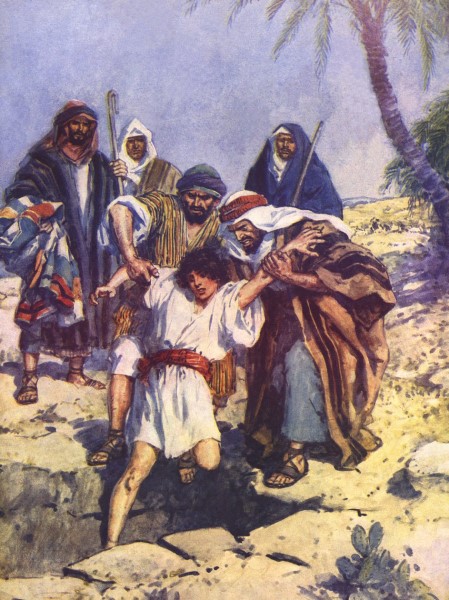
When read at face value, the eleven verses of Genesis 37:1–11 describe deeply troubling family and sibling dynamics, with both implicit and explicit signs of conflict.
To turn this story into a “medicine for the mind” borrowing Howard Deitcher’s expression, a sequence of pedagogical steps based on his bibliotherapy approach can be applied. In this article, I apply it in a hypothetical lesson for a group of 15- to 17-year-old high school students.
First, noticing the themes in the story helps set the stage for later discussion: Jacob’s favoritism of Joseph, resentment and hate among brothers, bringing negative reports about one’s siblings, and escalating the conflict by recounting his dreams.
These themes warrant what Deitcher called “guided reading,” encouraged by particular exploratory questions: “How do brothers respond when they hear about Joseph’s dreams?,” “How does the story make the favoritism visible?,” or “Is there a progression in how brothers respond over time to what Joseph does and says?”
Such close reading is an invitation to give voice to multiple viewpoints and provide a framework that connects the story to students‘ lived experience: “Why do parents sometimes show preference for one child openly?,” “How does it affect relations in the fam ily?,” “What does it take in sibling relationships to build mutual support rather than rivalry – and can parents help by modelling or helping students internalize certain values?,” or “Why do we sometimes say or do things that we know will make others hate us?”
To activate the story’s healing potential, the experience of the story characters needs to be felt by students, not just imagined. This is achieved by “mediating dialogue” when some students replay possible conversations while taking the role of Joseph’s brothers, another taking the role of Joseph, and still others playing Jacob or a less visible character from the story or even an imaginary character showing how Rachel might have responded to the situation, had she had a chance – with Rachel being the mother figure missing from Joseph’s life.
To follow up the mediated dialogue, Deitcher suggests follow-up activities, possibly involving an outside expert such as a psychologist specializing in family dynamics. Even watching an educational video or film excerpts on the topic of sibling rivalry is a relevant – and less logistically demanding – option.
To close the lesson, students need an opportunity to reflect on which perspectives speak to them, how their understanding of the story changed through the discussion, and if they see their own family relations in a new light through this experience. This internalization helps students make the learning their own and equips them to better navigate similar situations in their lives – with the story effectively doing the therapeutic work Deitcher describes.
This methodical sequence progresses from reader-level engagement with the text to personal encounter and ensures the students are familiar with the text before they are invited to see themselves in it.
To illustrate the application of the method, verses 2 to 4 can be taken as an example:
The theme is status in a family.
The guided reading question: “In light of the fact that Joseph’s mother Rachel had died, why is Joseph described in verse 2 as ‘a helper to the sons of his father’s wives Bilhah and Zilpah?’”
Multiple viewpoints question: “Why did Joseph bring bad reports on his brothers — and what does this action signal about his position within the family?”
Mediating dialogue arrangement: one person performs an internal monologue of 17-year-old Joseph after he is treated as a “helper” to his brothers.
Exploration for internalization: Reflect – individually or in pairs – on what you did to improve your standing in the family when you were made to feel like you mattered less.
Such sequence can help students feel another side of Joseph – typically admired for his character and closeness to God in later chapters – that of a teenager fighting for his place in the family.
As powerful as the tool of bibliotherapy is, it does require that students engage with the text not just intellectually but through personal encounter. The approach also has inherent challenges.
One challenge is allocating sufficient time for students not only to engage deeply with the text but also to bring that engagement to a proper close. The recommended sequence should not be abruptly ended without proper closure.
Second is psychological safety needed in case the story touches on a student’s deep vulnerability and leads to intense emotional reaction. This requires the teacher to adopt a non-typical role – not quite a regular teacher, and not yet a therapist – which the teacher must be confident in handling.
Third, it is a challenge on its own to shift the lesson objective from “students understand the narrative” to “students use the narrative to understand themselves.” The teacher needs to be aware that making the lesson more personal – even if still a pedagogical tool rather than a clinical therapy session – makes it emotionally more charged. Designing such an encounter with the text gives the teacher less room to retreat to the safety of simpler „content delivery.“
References
Deitcher, H. (2019). Bibliotherapy and teaching Jewish texts: “Medicine for the mind.” Religious Education, 114(1), 17–29. https://doi.org/10.1080/00344087.2018.1526363
